Snoqualmie Falls from Seattle: A Hundred Feet Taller Than Niagara, Best After Storms, and the Cherry Pie Twenty Minutes Away
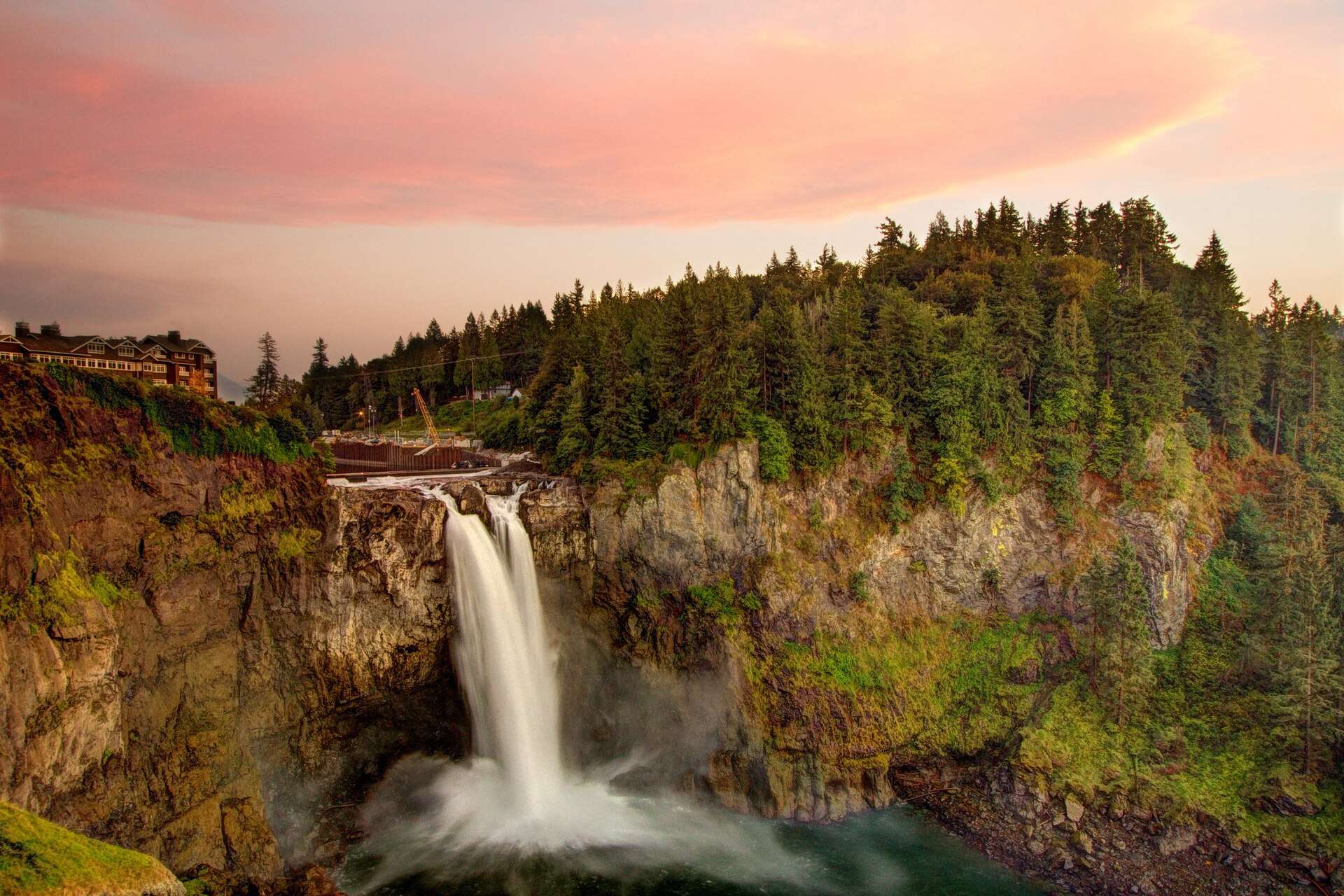
Forty minutes east and a hundred feet taller than Niagara — 268 feet of waterfall, free from the decks, thundering after storms and thinning by late summer. The Twin Peaks credits live here; the cherry pie is twenty minutes away.
The short version
- The drive runs I-90 east about forty minutes to the falls’ free viewing decks and gardens — the region’s most effortless natural spectacle, with paid-modest parking as the only gate (falls park information at snoqualmiefalls.com).
- The height fact per the alarm: 268 feet — roughly a hundred feet taller than Niagara — in a single curtain over the basalt lip, with the hydroelectric plant inside the cliff (running since 1899) as the engineering footnote the viewpoint plaques enjoy.
- The flow truth per the alarm is the planning fact: winter rains and spring melt run the falls at full thunder (spray reaching the upper decks), while late summer thins the curtain to a veil — the after-any-big-storm visit is the connoisseur’s timing in every season.
- The lower trail per the alarm trades a half-mile descent through the forest for the base-of-the-falls view and boardwalk — and the return climb the alarm bills plainly; the upper decks deliver the postcard without the knees.
- The Twin Peaks register per the alarm runs matter-of-fact: the falls and Salish Lodge above them are the series’ opening-credit Great Northern, and Twede’s Café in North Bend — the double-R diner — leans into the cherry-pie-and-damn-fine-coffee pilgrimage twenty minutes east.
- Rattlesnake Ledge per the alarm is the real-hike add: about four miles round trip to the ledge’s Cedar River valley panorama, popular to the point of weekend queues at the viewpoint — with Snoqualmie Pass conditions (wsdot.com) as the standing check before deeper winter ambitions east.

Getting there
The forty-minute simplicity makes this the network’s lowest-commitment spectacle — no booking, no gate, decks open dawn to dusk. The day scales by appetite: falls-only runs ninety minutes door to door; adding the lower trail, North Bend’s pie, and Rattlesnake builds the honest half-day-plus. Rain that ruins other plans improves this one per the alarm’s flow logic, which makes Snoqualmie the region’s best bad-weather trump card. Weekend middays fill the main lot; mornings walk straight on.
The day
The upper decks land the postcard immediately — the full 268-foot curtain, the gorge, the lodge on its lip — with the spray volume reporting the season per the alarm’s rain math. The lower trail’s forest half-mile buys the base view: the river regathering, the curtain overhead, and the climb back that the alarm priced honestly. North Bend takes the middle: Twede’s cherry pie and coffee done straight-faced, Mount Si filling the windshield like set dressing, and the railway museum’s vintage stock in Snoqualmie town for the train-minded. Rattlesnake Ledge fills the ambitious afternoon — the switchbacks, the ledge, the valley below, and the shared-summit sociology of the region’s most popular short hike. The drive home runs against the mountains’ evening light, forty unremarkable minutes from the thunder.
When to go
November through June runs the falls at strength — winter storms and spring melt are the full-thunder windows per the alarm, and any season’s big rain restores the show within a day. July through September trades volume for gardens and reliable trail weather; the veil version still photographs, just quieter. Fog fills the gorge on cold mornings memorably. Winter ambitions east of North Bend defer to pass conditions per the alarm’s standing check; the falls themselves stay reachable in all but the rare lowland snow event.
Frequently Asked Questions
Is it really taller than Niagara?
By the numbers, yes: 268 feet against Niagara’s ~167 — the comparison every plaque and local makes, per the alarm’s opening. Niagara’s argument is width and volume; Snoqualmie’s is height and the single clean drop. Both are right, and only one is forty minutes from Seattle with free decks.
How different is the flow really?
Dramatically: winter storm flow throws spray onto the upper decks and drowns conversation; late-summer flow splits around the lip into a lace veil. The hydro plant diverts a share year-round under its license, which sharpens the seasonal contrast. The alarm’s match-expectations-to-the-rain clause is the entire planning doctrine.
What’s actually at the Twin Peaks sites?
The falls-and-lodge exterior is the opening credits’ Great Northern (the lodge interior differs — it was filmed elsewhere), and Twede’s Café played the Double R, serving the pilgrimage’s cherry pie with self-aware good humor. Drive-by fans cover both in an hour; the deeper filming-location circuit around North Bend repays the committed with a printed map and modest expectations.
Is Rattlesnake Ledge dangerous?
The trail is well-built and family-popular; the ledge itself is unrailed cliff edge where the risk concentrates — the standing rules are firm footing, children in hand, and distance from the lip, especially in wind or wet. The crowds per the alarm are the other hazard: weekend viewpoint queues are real, and the early start is the answer to both.
Snoqualmie or Leavenworth or Rainier from Seattle?
All documented on this network: Snoqualmie for the forty-minute spectacle, Leavenworth for the invented-Bavaria day up US-2, Rainier for the full mountain commitment with its cancelled-timed-entry math. Effort ascending in that order — and Snoqualmie is the one that improves in rain, which in this region is a superpower.